
Self Defense

What to Say to Police After a Self-Defense Shooting in Arkansas
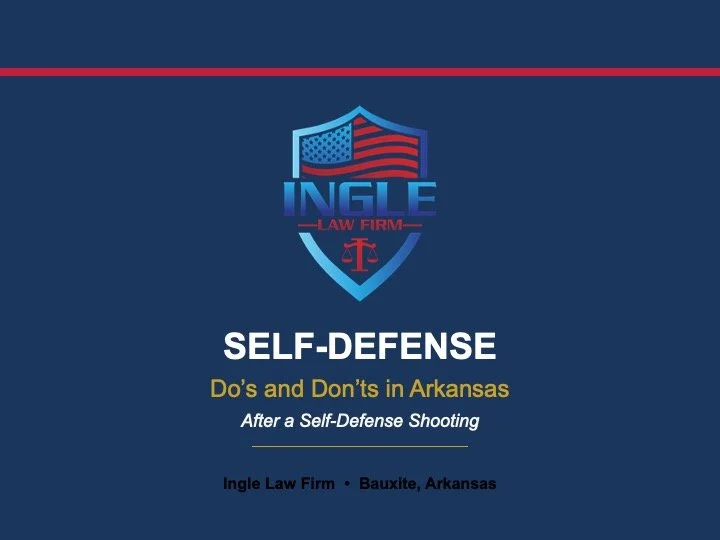
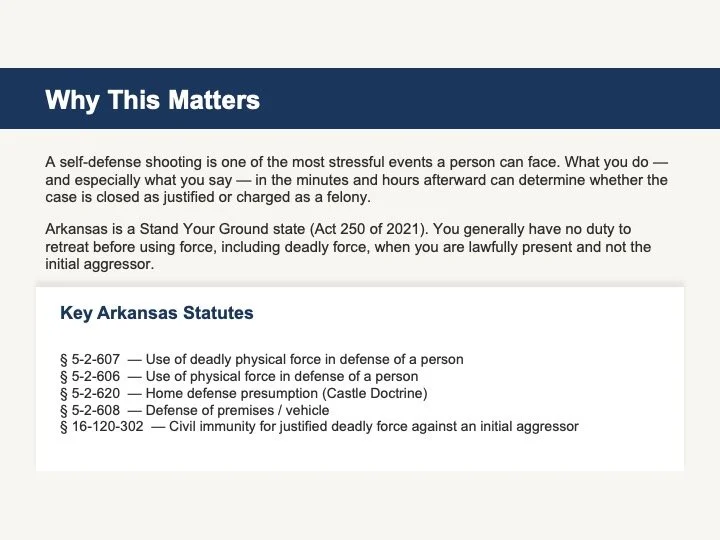
Arkansas law allows you to defend yourself, including with deadly force under the state’s Stand Your Ground rules (Act 250 of 2021) and Ark. Code Ann. § 5-2-607. But what you say in the minutes after a self-defense shooting can matter as much as the facts of the incident itself.
A binary choice between “tell everything immediately” and “refuse to speak at all” often creates unnecessary legal exposure. The widely recommended approach is a short, controlled initial basic statement: establish that you were the victim who acted in self-defense, point out key evidence and witnesses, then clearly invoke your right to counsel before giving any detailed interview or formal recorded statement.
The Immediate On-Scene Protocol After a Self-Defense Shooting
In the immediate aftermath of a critical incident, physiological stress—tunnel vision, auditory exclusion, and memory fragmentation—makes an accurate, narrative retelling nearly impossible. Investigators will later hold you to every misspoken estimate of distance, sequence, or timing.
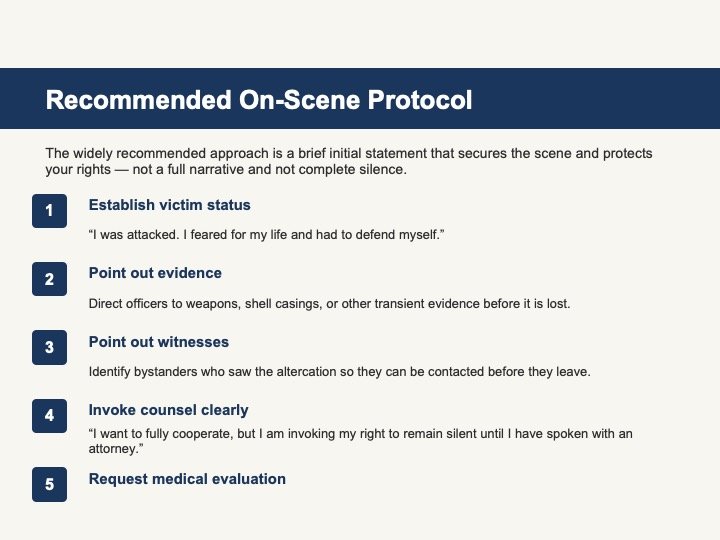
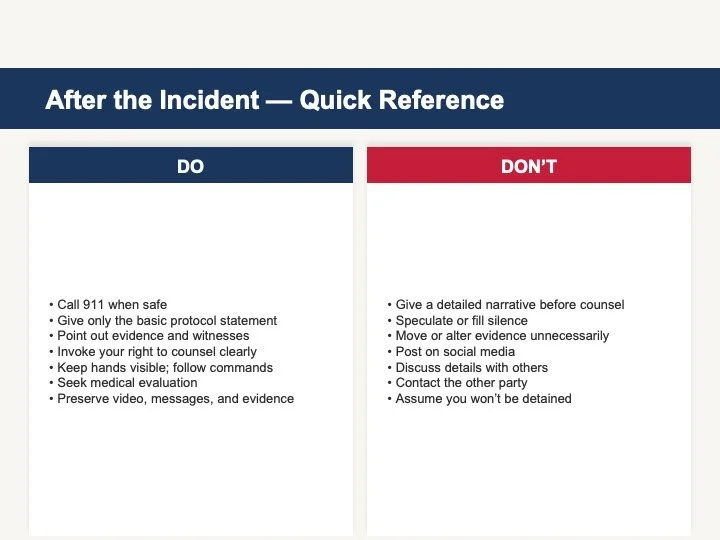
The standard best practice on scene involves five core points:
Establish victim status
Clearly identify yourself as the person who defended against an attack.
Example: “I was attacked. I feared for my life and had to defend myself.”Point out evidence
Alert responding officers to transient evidence before it is lost or contaminated.
Examples: “He dropped a knife over there by the curb” or “The shell casings are in the grass.”Point out witnesses
Direct officers to bystanders who may leave the scene.
Example: “The driver in that silver sedan saw the whole altercation.”Offer full cooperation while invoking your rights
Explicitly invoke your rights under the Fifth and Sixth Amendments.
Example: “I want to fully cooperate with the investigation, but because of the stress of this incident, I am invoking my right to remain silent until I have spoken with an attorney.”Request medical evaluation
Adrenaline masks shock, elevated heart rate, and physical injuries sustained during the struggle. Ask to be checked even if you feel fine.
The Legal Landscape in Arkansas
Self-defense as justification (Ark. Code Ann. § 5-2-607)
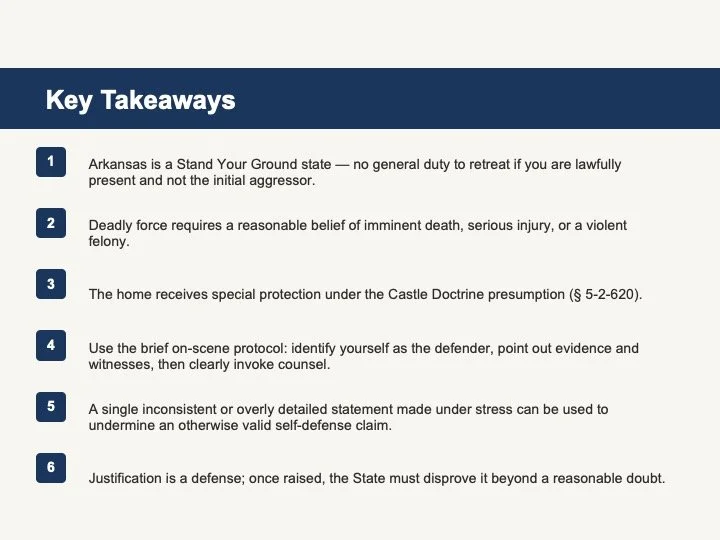
Under Arkansas law, self-defense is a justification defense. Once you introduce some evidence that you acted to protect against imminent unlawful deadly physical force, the State must disprove self-defense beyond a reasonable doubt. An immediate, unvetted narrative does not clear you on the spot. Inconsistencies between a shock-induced statement and physical evidence (trajectory, ballistics, video, etc.) can be used by prosecutors to undermine your credibility.
Stand Your Ground (Act 250 of 2021)
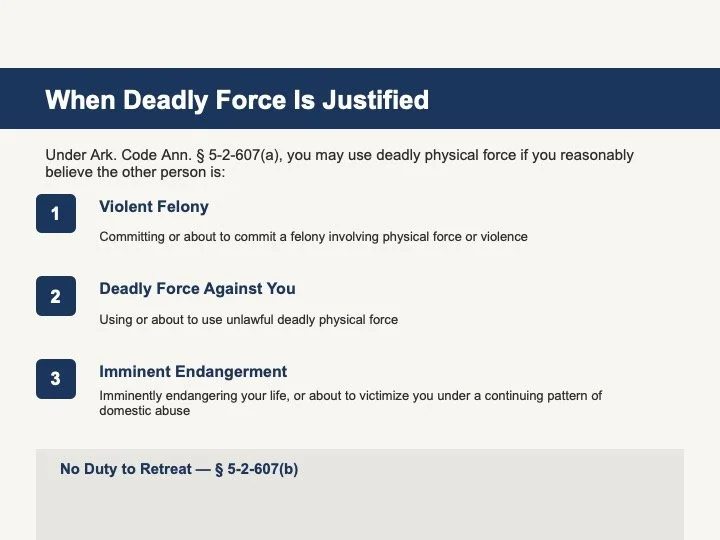
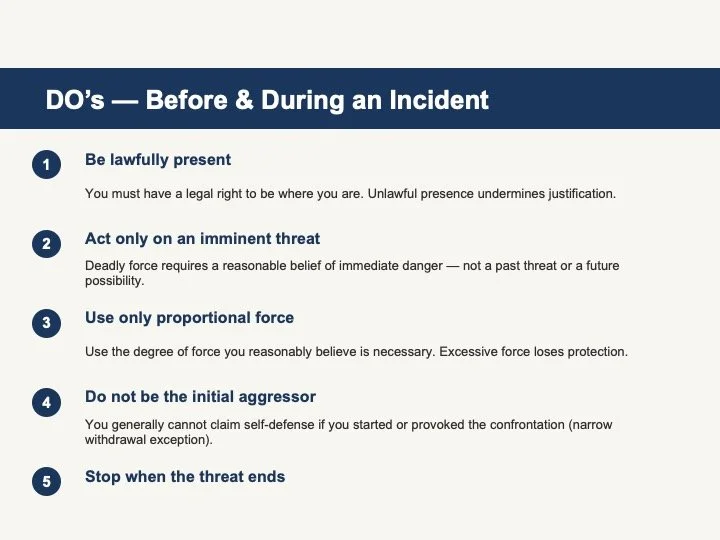
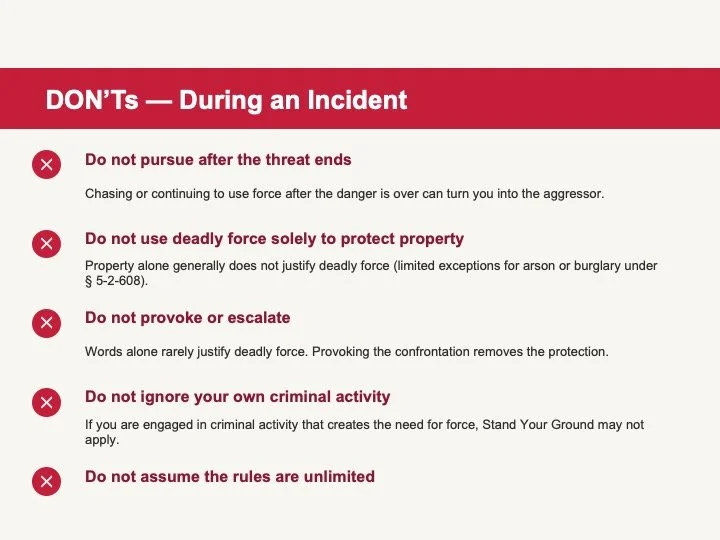
Arkansas eliminated the general duty to retreat when you are in a place you have a lawful right to be, are not engaged in unlawful activity, and are not the initial aggressor. Establishing that you were not the initial aggressor, however, often depends on consistent facts and corroboration. Those details are best assembled calmly after you have reviewed the timeline with an attorney.
The need to invoke clearly
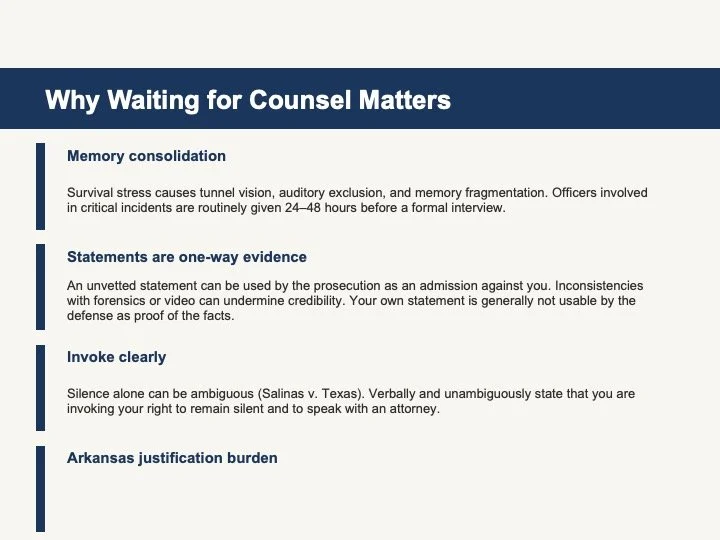
Simply remaining completely silent can be ambiguous in certain pre-custodial settings (Salinas v. Texas). You must verbally and unambiguously state that you are invoking both your right to remain silent and your right to an attorney.
Why Waiting for Counsel Matters After a Self-Defense Incident
Memory consolidation — Law enforcement officers involved in critical incidents are routinely given 24 to 48 hours and a sleep cycle before a formal interview. Perception under survival stress frequently differs from what video or physical evidence later shows.
Statements are one-way evidence — An unsworn or custodial statement you make can generally be introduced by the prosecution as an admission against you. Your own defense team usually cannot use the same statement to prove the truth of what you said. Any inconsistency can be used to impeach you.
Professional coordination of the formal statement — An attorney can arrange a voluntary interview or submit a formal written statement once physical evidence, 911 audio, and available video (dashcams, Ring doorbells, surveillance) have been identified and preserved.
Bottom Line
Arkansas self-defense and Stand Your Ground laws protect the right to defend yourself. They do not protect against the damage a single inaccurate or overly detailed statement can cause when given under extreme stress. The safer path is the brief on-scene protocol above, followed by an immediate call to counsel.
If you have been involved in a self-defense shooting or critical incident in Arkansas, contact Ingle Law Firm immediately.
Call (501) 326-5026 or visit www.theinglelawfirm.com.
This information is for general educational purposes only and does not constitute legal advice. Outcomes depend on the specific facts of each case. Consult qualified Arkansas counsel regarding your situation.
You survived the scene. Don’t lose in the courtroom.
The danger doesn’t end when the shooting stops. If you were involved in a self defense shooting or incident, contact a lawyer immediately.